Calligrapher and Social Activist
Author: Mohsen Sharifi
Second Edition, Volume One of the Hazara Encyclopaedia
Pages 493–494
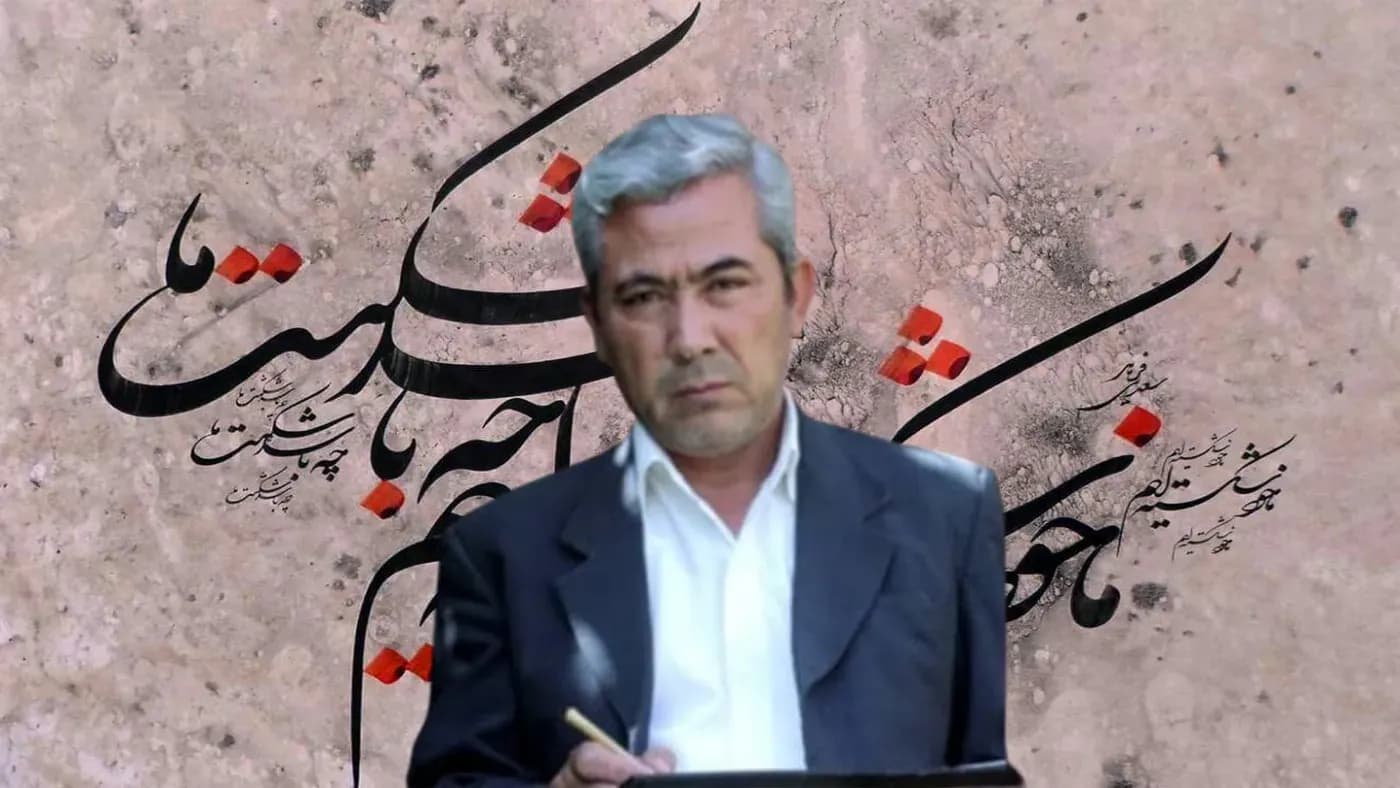
Salman Ali Uruzgani, son of Mirza Muhammad Isa, was born in 1340 SH / 1961 CE in the village of Baghchar, Khas Uruzgan District. His father was a government employee. When Uruzgani was six years old, his father’s government employment led the family to move to Helmand Province. He completed his primary and secondary education there (Uruzgani, 1396).
After successfully passing the university entrance examination (Kankor) in 1358 SH, he enrolled at Kabul University. However, because of the changing political situation in the country following the coup of 7 Saur 1357 SH, he left university before completing his studies and migrated to Iran in 1360 SH.
Because of his interest in calligraphy, Uruzgani joined the Iranian Calligraphers Association in 1360 SH, where he learned the Nasta‘liq and Shekasteh Nasta‘liq scripts from masters including Gholam Hossein Amirkhani, Keykhosrow Khoroush, Yadollah Kaboli, and Mohammad Heidari. In 1364 SH, he received the Association’s “Excellent” (Momtaz) qualification in calligraphy. He subsequently completed its advanced “Superior Excellence” (Fowq-e Momtaz) course (Asil Yousefi, 1384: 399–400).
In 1378 SH, Uruzgani received a bachelor’s degree in Graphic Design from the Faculty of Fine Arts at the Tehran branch of Islamic Azad University (Asil Yousefi, 1384: 399–400).
In the middle of 1379 SH, Uruzgani migrated to Pakistan, where for three years he taught fine arts—including calligraphy, painting, and drawing—at cultural centres in Quetta. He also taught history, geography, and Dari Persian at schools established specifically for Afghan refugees living in Quetta (Uruzgani, 1396).
In 1384 SH, he was appointed head of the Afghanistan Independent Human Rights Commission’s office in the newly established Daykundi Province. Beginning in 1388 SH, he served for two years as Director of Publications for the Afghanistan Independent Human Rights Commission in Kabul (ibid.).
In early 1390 SH, after undertaking various other activities, Uruzgani returned to his principal profession of calligraphy. From 1394 SH onwards, he served as head of the Afghanistan Calligraphers Association (Uruzgani, 1396).
Uruzgani considers his finest work to be a portrait of Abdul Ali Mazari, Secretary-General of the Hezb-e Wahdat-e Islami Afghanistan [Islamic Unity Party of Afghanistan], which he created in 1372 SH. The piece is based on a poem by Mohammad Hassan Hosseinzadeh (born 1341 SH) and combines portrait drawing with siah-mashq [calligraphic practice composition] in the Nasta‘liq script (Uruzgani, 1393). Uruzgani’s principal styles and areas of expertise in calligraphy are Nasta‘liq and Shekasteh Nasta‘liq (Uruzgani, 1376: 19).
Uruzgani’s cultural and artistic activities include:
1. Founding the Contemporary Afghan Calligraphers Association in exile, together with a number of other Afghan émigré calligraphers, in Tehran in 1367 SH.
2. Collaborating with cultural publications produced by Afghan migrants in Iran and working in the fields of culture and art during the period of civil war in Afghanistan.
3. Serving on the editorial boards of the magazines Sham‘-e Awaragan and Ershad in Quetta, Pakistan, as well as the magazines Human Rights and Contemporary Literature of Afghanistan.
4. Producing hundreds of works in calligraphy, painting, caricature, and graphic design.
5. Holding fourteen solo exhibitions and participating in ten group calligraphy exhibitions inside and outside Afghanistan.
6. Calligraphically transcribing the 150-page Divan of poetry by Dabestani in Iran.
7. Serving as a member of judging panels for numerous artistic competitions in calligraphy and painting (Uruzgani, 1396).
Among Uruzgani’s published works in the field of calligraphy is Mulk-e Del: Selected Calligraphic Works from the National Archives by Earlier Afghan Calligraphers. Together with Ali Baba Aurang and Abdul Rashid Osman, he also published Bu-ye Bahar: A Collection of Works by Contemporary Afghan Calligraphers (Fars News Agency, 1393).
Sources: Uruzgani, Salman Ali. (1376). “Life on the Border Between Profession and Art: An Interview with Contemporary Calligrapher Salman Ali Uruzgani.” Dorr-e Dari Quarterly, nos. 3–4, pp. 13–21; Uruzgani, Salman Ali. (1396). “Autobiography of Salman Ali Uruzgani.” Submitted to the Encyclopaedia Office, 12 Dalwa 1396; Uruzgani, Salman Ali. (1393). “Interview with Salman Ali Uruzgani.” Shafaqna website. Retrieved 9 Saratan 1397; Asil Yousefi, Mohammad Rafi. (1384). Rang-o Ranj. Mashhad: Sonbola; Fars News Agency. (1393). “Mulk-e Del, a Selection of Calligraphic Works, Published.” Retrieved 9 Saratan 1397.
Loading comments...