

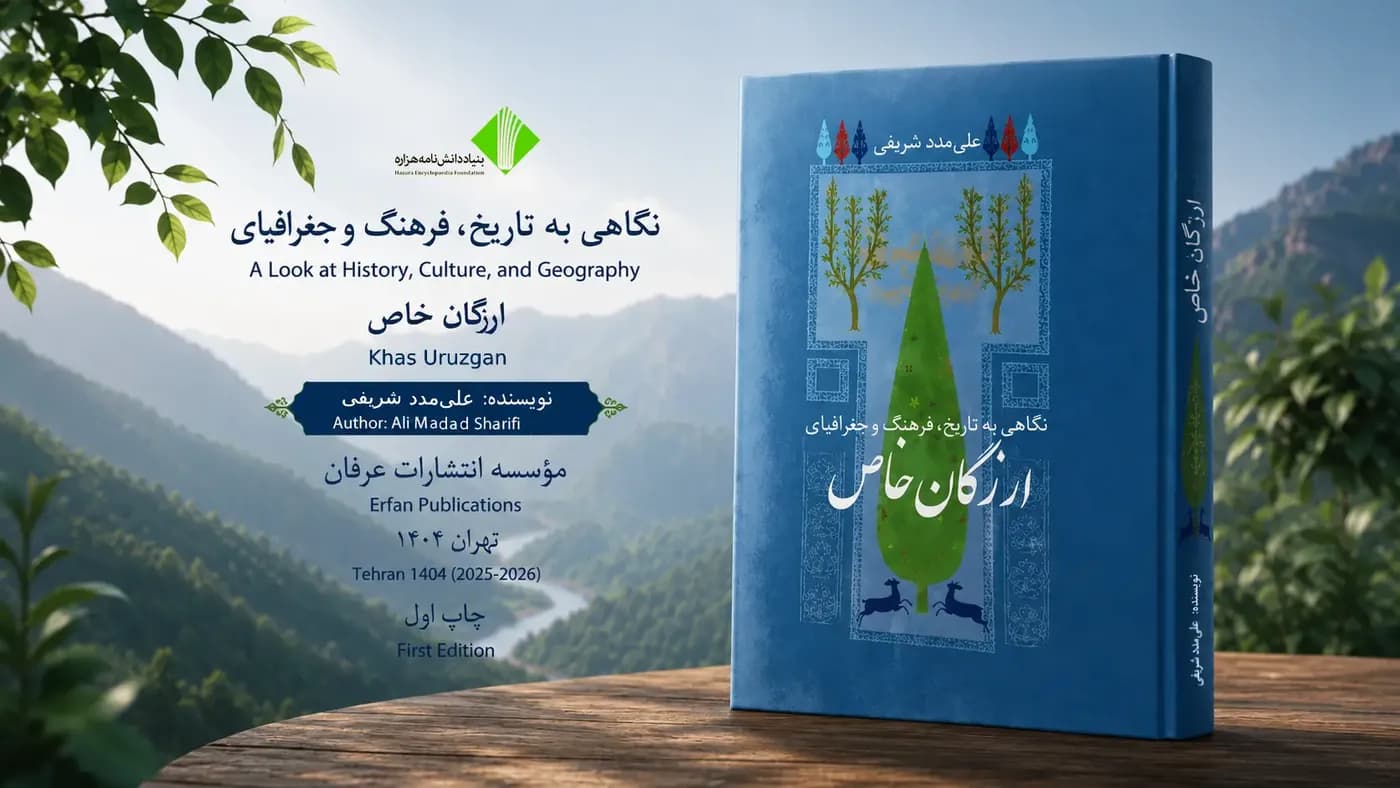
The book A Look at the History, Culture, and Geography of Khas Uruzgan was written by Ali Madad Sharifi. Sharifi is a Shi‘a religious scholar from Ghazni Province, Afghanistan. He began pursuing religious studies seriously, first in his home region and subsequently in Khas Uruzgan, before migrating to Iran to continue and complete his education. Sharifi has devoted many years of his life to study, writing, and the promotion of religion. Alongside his studies, he also remained involved in the jihad and resistance of the Muslim people of Afghanistan. For many years, he worked in the cultural committee of one of the jihadi groups in support of the mujahideen. Several works authored and researched by Ali Madad Sharifi, both individually and collaboratively, have been published.
The book was edited by Parvin Walizadeh, who authored the section on the history of Khas Uruzgan. It was published by Erfan Publishing Institute in Tehran in 1404 SH, comprising 574 pages, with a print run of 1,000 copies.
The book recounts previously undocumented aspects of the period of armed struggle in the region of Khas Uruzgan. It focuses particularly on the events and activities surrounding one military base, the Ali ibn Abi Talib Base of Khas Uruzgan, examining the activities of its commander, Muhammad Aslam Salehi, and the fighters based there. According to the author, the base and its commander played a prominent, fundamental, and decisive role in developments in the region at the time. After 130 years, the Hazaras were able to live securely in their own areas and experience a sense of freedom and dignity (Sharifi, 1404: 25)
The book is organised into seven sections. The first section, “The History and Geography of Khas Uruzgan,” consists of two chapters: one examining the position and historical background of Khas Uruzgan and another discussing Uruzgan during the reign of Abd al-Rahman Khan. The first chapter examines the origins of the name “Khas Uruzgan” as well as the region’s geographical and historical position. The second addresses such topics as conditions in Uruzgan before the war, Abd al-Rahman’s objectives in attacking Uruzgan, the uprising and resistance of the population, the stage of takfir [declaration of unbelief] and the transition from a policy of conquest to one of elimination, the Forty Hazara Girls (Chehel Dokhtaran-e Hazara), and the displacement of the Hazara population.
The second section is entitled “Regions and Tribes of Khas Uruzgan.” It likewise consists of two chapters, one covering the regions and villages and the other the tribes of Khas Uruzgan. The first discusses Hazara-inhabited and Pashtun-inhabited areas, while the second introduces various tribal and community groups, including the Hazara, Nikruz, Behruz, Shali, Baghchar, and others.
The third section provides a general examination of selected events in the contemporary history of Khas Uruzgan. These include the Kotal-e Shalbatu incident during the period of Habibullah Kalakani; Mulla Ibrahim’s efforts to retake several villages in Uruzgan; the conflict involving Lal Muhammad Khan Kuchi; events of the 1340s and 1350s SH; the establishment of the Ali ibn Abi Talib Base in the 1360s SH; and the establishment of Hezb-e Wahdat in 1368 SH. In discussing these events, the book also recounts Muhammad Aslam Salehi’s role where relevant.
The fourth section, “Khas Uruzgan During the Taliban Period,” discusses the first period of Taliban rule, the killings in Baghchar, negotiations between the Taliban and Salehi’s men, Uruzgan during the period of the Islamic Republic, and Uruzgan following the collapse of the Republic and the Taliban’s return to power.
The fifth section is devoted to the biography of Muhammad Aslam Salehi. It covers his birth, educational activities, cultural and social activities, his life as a fighter and activist up to his killing by the Taliban, his personal characteristics, and recollections of him provided by others.
The sixth section is entitled “The Educational System and Brief Introductions to Selected Figures of Khas Uruzgan.” Its subsections examine the educational system, cultural decline, the educational system of religious seminaries, the government education system, the Siyabghul and Pik schools, Baghchar School, the names of schools in Khas Uruzgan District, and biographies of a number of Uruzgan’s religious scholars and other notable figures.
The seventh and final section consists of appendices, including letters, a resolution, a peace agreement, and a photographic album featuring Salehi and some of his commanders.
The historical and geographical sections of the book are based on written and library sources, with the exception of some information concerning the villages and communities of Uruzgan, for which notes compiled by the group supporting the book were used. The group, which provided both financial support for the book and information for its contents, had been gathering material for two years prior to its publication. Its members collected notes and accounts from Salehi’s associates and commanders.
The members of this group were Asadullah Ehsani, Muhammad Juma Tawakkoli, Khodadad Rezvani, Awaz Ali Qurbani, Ghulam Sakhi Muhammadi, and Abdul Aziz Hedayati. The largest number of notes and accounts were provided by Asadullah Ehsani and Muhammad Juma Tawakkoli.
Source:
Sharifi, Ali Madad. (1404 SH). A Look at the History, Culture, and Geography of Khas Uruzgan. Tehran: Erfan Publishing Institute.
Fatima Khawari, Asad 1405 SH, Mashhad.
Loading comments...