

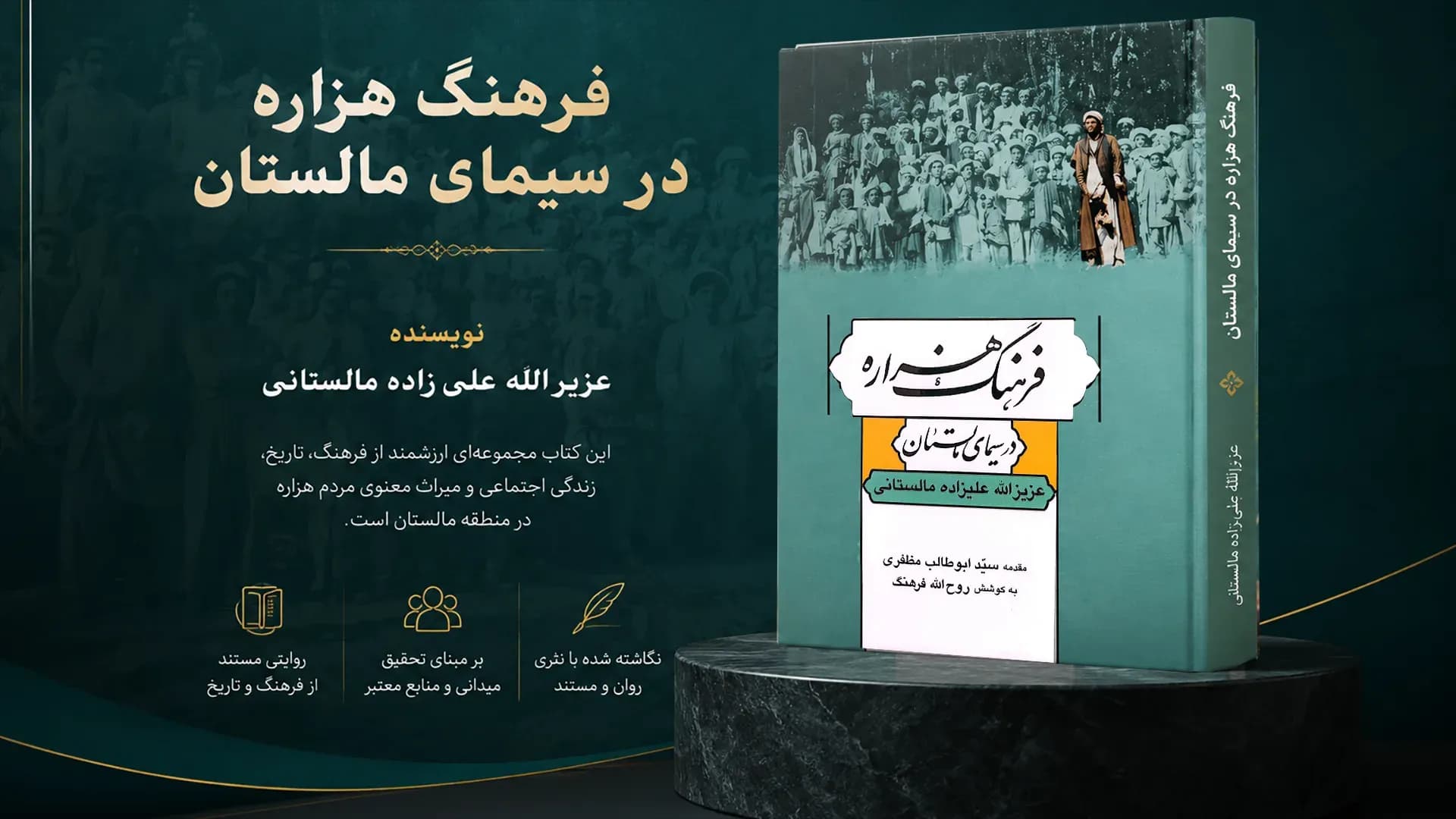
The book Hazara Culture as Reflected in the People of Malistan, written by Hojjat al-Islam Sheikh Azizullah Alizadeh Malistani, is a notable and comprehensive work in the fields of cultural studies, ethnography, and local history of Afghanistan. This valuable work is the result of several decades of field research, observation, conversations with local residents, and the author's personal memories and experiences, compiled in a scholarly and systematic manner.
The book is rooted in the social and cultural realities of the region. Despite the political changes Afghanistan has undergone in recent decades, the author has maintained a continuous presence in Ghazni Province and Malistan District. Much of what he recounts about the society, history, and culture of the region is based on his own firsthand observations. The result is a collection of direct and firsthand experiences that he has presented to readers in written form.
The foreword by the distinguished writer Abu Taleb Mozaffari is one of the notable features of the book. He considers the author's simple and unpretentious prose to be one of the work's important characteristics. In his view, Alizadeh employs a variety of writing forms in this work, ranging from essay writing to encyclopedic and lexicographical formats, as well as first-person writing, such as memoirs. Each of these forms has its own particular standards and conventions, making the undertaking a challenging one.
Structure and Content: From Geography to Riddles
The book is organized into five main sections and spans more than 1,000 pages:
Part One, titled Understanding Malistan, introduces the region's physical and human geography, tribes, villages, rivers, plants, animals, tribal elders, religious scholars, poets, artists, and educational and healthcare centers.
Part Two is devoted to Hazara culture in Malistan. It provides a detailed and documented account of customs and traditions, foods, handicrafts, local beliefs, folktales, proverbs, humorous stories, and ritual ceremonies such as weddings, Chela-bori, vows and offerings, and funeral ceremonies.
Part Three compiles the colloquial vocabulary used by the people of the region and arranges it alphabetically.
Part Four is devoted to personal memories and historical narratives. It contains valuable observations on everyday life, migrations, wars, traditional healing practices, spiritual practices, and even social media.
Part Five consists of a gallery of historical photographs, manuscripts, and visual elements of Malistan's cultural heritage.
The Importance of the Book for Hazara Culture and Local Studies
Hazara Culture as Reflected in the People of Malistan is not only a local ethnographic reference but also, in a sense, a cultural database of the region.
From an anthropological perspective, the author seeks to document, with care and respect, the cultural nuances, oral traditions, local expressions, and traditional educational system of the region. His use of local vocabulary, precise phonetic transcription, and representation of the living language of the people also makes the work a valuable resource for linguists and cultural researchers.
At a time when local cultures are rapidly being forgotten, works such as this have particular value. The book provides a significant example of documenting cultures at risk of disappearing and may serve as a useful model for researchers studying other regions.
📘 The book was published in spring 2025 (1404 SH) by Dar al-Ilm Publications in Qom, in a 1,014-page edition, and is scheduled to be officially launched soon.
Loading comments...