
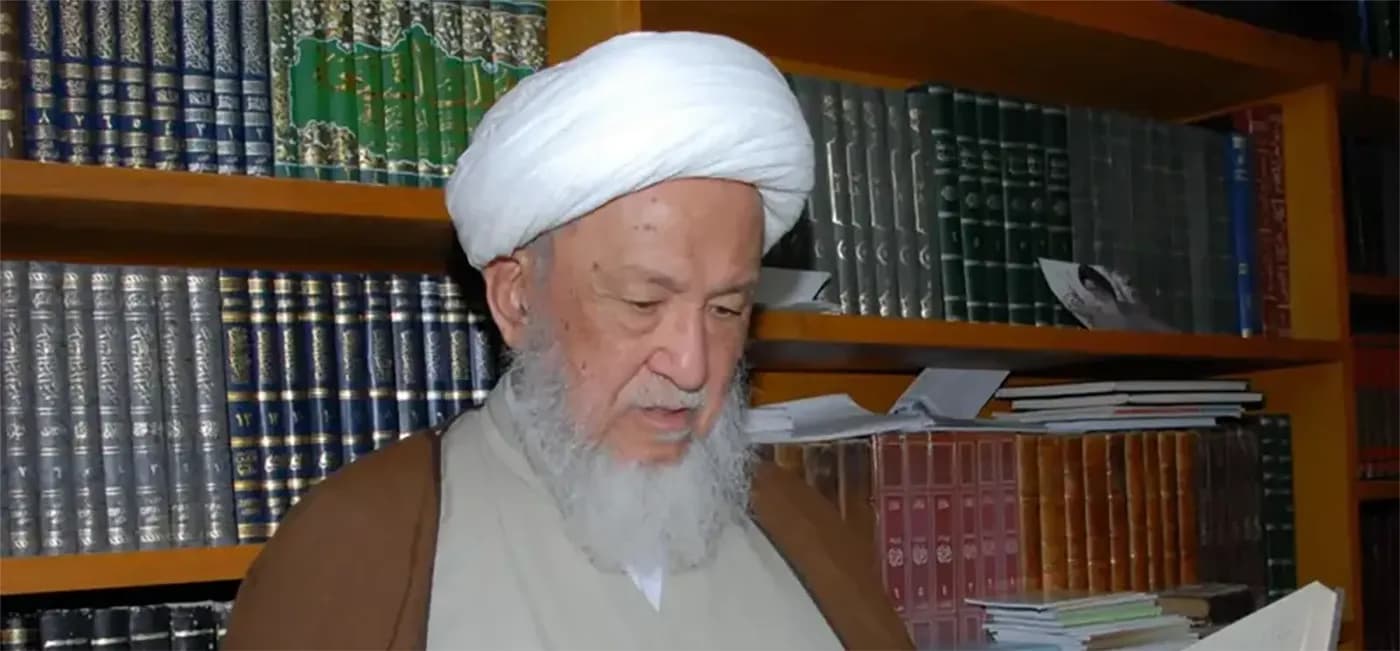
On Thursday, 18 Dhu al-Hijjah 1447 AH / 4 June 2026 / 14 Jawza 1405 SH, the Shi‘a world lost one of its maraji‘ al-taqlid [supreme religious authorities]: Grand Ayatollah Muhammad Ishaq Fayyaz died in Baghdad at the age of 96.
Sheikh Muhammad Ishaq Fayyaz, son of Muhammad Riza, was born in 1309 SH in the village of Soba, Jaghori District. His family was originally from the Shirdagh area of Malistan District. His father had migrated from Shirdagh to Jaghori and settled there. Muhammad Ishaq began learning to read and write at the age of five in the traditional maktab of his home village and studied the introductory religious sciences at the Uqtul religious seminary in Jaghori. His teachers included Qurban Ali Wahidi and Ramazan Ali Sharifi (WikiShia, 2026).
After completing his preliminary studies in his homeland and following the death of his mother, Sheikh Muhammad Ishaq Fayyaz travelled to Iran, reportedly at the age of eighteen. He spent one year at the Haj Hasan School in the Bala Khiyaban neighbourhood of Mashhad, where he studied Hashiya-yi Mulla Abdullah (on logic) and part of Mutawwal (on semantics, rhetoric, and eloquence) under Sheikh Muhammad Husayn Nishaburi. He subsequently travelled to the city of Qom (ibid.).
His stay in Qom was brief, after which he migrated to Najaf and took up residence at the Salimiyya School in the Mashraq neighbourhood. Sheikh Muhammad Ishaq studied Mutawwal under Muhammad Ali Mudarris Afghani; and Qawanin al-Usul, Hashiya-yi Mulla Abdullah, and Sharh al-Lum‘a under Mirza Kazim Tabrizi, Sayyid Asadullah Madani, and Mirza Ali Aqa Falsafi. He studied Kifayat al-Usul, Rasa’il, and Makasib al-Muharrama under Sheikh Mujtaba Lankarani.
At the age of twenty, Sheikh Muhammad Ishaq Fayyaz entered the advanced level of study known as dars-e kharij at the Najaf seminary and began attending the lessons of Sayyid Abu al-Qasim al-Khoei. He remained a student of Ayatollah al-Khoei for fifteen years. During the latter part of this period, Fayyaz assisted with the work of Ayatollah al-Khoei’s office and accompanied him on journeys to various cities. He was also a member of Ayatollah al-Khoei’s council for responding to religious and jurisprudential questions (istifta’at) (Naseri Davoudi, 1390: 505).
Ayatollah Fayyaz regarded his book Muhadarat fi Usul al-Fiqh—one of the principal sources for research into the principles of jurisprudence in Imami Shi‘a seminaries—as the product of his many years attending Ayatollah al-Khoei’s lessons. The work is regarded as the most authoritative written record of Ayatollah al-Khoei’s lectures on usul, and many teachers at the Najaf seminary consider it the most precise and thoroughly refined account of al-Khoei’s teachings on the principles of jurisprudence (Office of Ayatollah Fayyaz).
Until 1356 SH, Sheikh Muhammad Ishaq Fayyaz taught advanced seminary texts at the Hindi Mosque and al-Jami‘a al-Diniyya al-Najaf. In that year, he began teaching dars-e kharij at the Sayyid Yazdi School in the Amara neighbourhood. Following the opening of Ayatollah al-Khoei’s Dar al-‘Ilm School in 1359 SH, Sheikh Muhammad Ishaq’s classes were transferred there. When the school was demolished during the rule of Iraq’s Ba‘ath regime, his classes were held briefly at the Hindi Mosque before being transferred once again to the Sayyid Yazdi School. He continued teaching there in Arabic until the end of his life.
Among Ayatollah Fayyaz’s prominent students in Afghanistan were Sheikh Hashim Salehi Mudarris (head of the Shi‘a Ulama Council), Amini Bamiyani, Nader Mahdavi, Ali Rafi‘i, Ali Murawwij, and Ghulam Husayn Akhlaqi, among others.
Islamic Government in the Thought of Grand Ayatollah Muhammad Ishaq Fayyaz
Among contemporary Shi‘a religious authorities, Ayatollah Fayyaz held a distinctive view regarding Islamic government and the wilayat al-faqih [guardianship of the Islamic jurist]. The most important feature of his political thought was that he conceptualised the authority of the jurist within the framework of a government based on law, justice, and the consent of the people, and did not regard the powers of the ruler as absolute or unlimited.
His views can be found in his Arabic treatise al-Anmudhaj fi Manhaj al-Hukuma al-Islamiyya (Persian translation: The Model of Islamic Government). In his view, Islamic government can take two forms. The first is a government headed by the most learned, fully qualified wali faqih [guardian jurist], in which the entire political and social system is established on the basis of Islam. The second is a government that is not headed by a wali faqih, but whose laws do not contradict Islam and in which the majority of the population is Muslim. He considered this second form of Islamic government appropriate for countries such as Iraq and Afghanistan, given the complexities and structures of their societies (ibid.).
Ayatollah Fayyaz’s Views on Women
Ayatollah Fayyaz held distinctive views concerning women’s rights and their position in society. From his perspective, the principal criteria for assigning responsibilities were competence, commitment, and observance of Islamic principles rather than gender.
He authored a book entitled The Position of Women in the Political System of Islam, comprising his responses to questions concerning women’s political, social, and jurisprudential rights in Islam. In his view, with the exception of a small number of specific positions—leadership, judgeship, and the issuing of religious rulings (fatwas)—women in an Islamic government have the right to work in all professions and hold public offices, including executive and legislative positions, provided that Islamic principles are observed. He also considered it permissible for qualified women to hold all offices and positions within a non-Islamic government (ibid.).
The Ayatollah Fayyaz Foundation was established in Afghanistan in 1396 SH and formally registered with the Ministry of Justice of the Islamic Republic of Afghanistan. Prior to this, it had been registered with the Ministry of Justice in 1393 SH under the name “Ayatollah Fayyaz Social Association.”
The foundation provides monthly financial support to more than 21,000 orphaned children. Its activities have also included establishing more than 200 deep wells and drinking-water networks in deprived areas; establishing and equipping eight hospitals; providing scholarships to more than 200 students studying midwifery; distributing thousands of food packages and providing financial assistance to vulnerable families throughout Afghanistan’s provinces; and regularly distributing fuel to impoverished families each year, among other activities.
Works and Writings
Ayatollah Fayyaz left behind more than forty significant works on jurisprudence, principles of jurisprudence, and social and political issues. Among his major works are Muhadarat fi Usul al-Fiqh, Ta‘liqa ‘ala al-‘Urwa al-Wuthqa, Minhaj al-Salihin, Ahkam al-Bunuk, Manhaj al-Hukuma al-Islamiyya, Mawqi‘ al-Mar’a fi al-Nizam al-Siyasi al-Islami, al-Masa’il al-Tibbiyya, and Tawdih al-Masa’il.
Sources:
Office of the Religious Authority Grand Ayatollah Sheikh Muhammad Ishaq Fayyaz. (1405 SH). “Works of Grand Ayatollah Sheikh Muhammad Ishaq Fayyaz.” Retrieved 30 Saratan 1405.
Naseri Davoudi, Abdul Majid. (1390 SH). Prominent Figures of Shi‘ism in Afghanistan. Vol. 2. 1st ed. Qom: Al-Mustafa International Centre for Translation and Publication.
WikiShia. (1405 SH). “Muhammad Ishaq Fayyaz.” Retrieved 30 Saratan 1405.
Author: Muharram Ali Khalili
Loading comments...