
Researcher and University Professor
Authors: Mohammad Javad Alavi and Parvin Walizadeh
Volume One, Second Edition
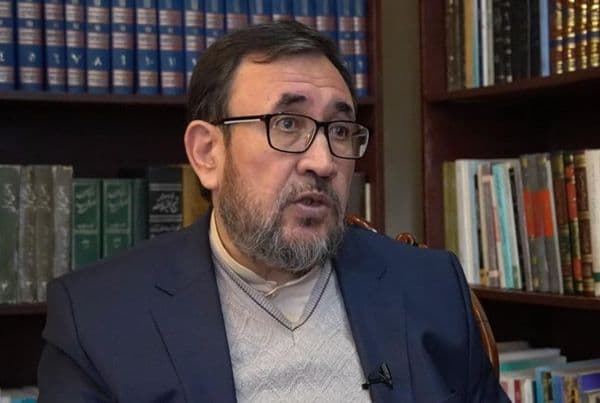
Mohammad Amin Ahmadi, son of Bustan Ali, was born on 15 Sonbola 1342 SH / 6 September 1965 CE in the village of Baghchar, Khas Uruzgan District, Uruzgan Province. He belongs to the Dai Chopan tribe and, through twelve generations, traces his ancestry to Sohbat Khan, a descendant of Amir Chopan (Ahmadi Baghchari, Memoirs).
In his home village, Ahmadi studied the Si Para, Panj Ketab [Five Books], and the Divan of Hafez under his paternal uncle, after which he attended a government school. He studied Jami‘ al-Muqaddamat and part of Suyuti under Mulla Muhammad Nazar Akhund in Baghchar. From the autumn of 1354 until the summer of 1357 SH, he studied Suyuti, Hashiya, and Ma‘alim under Muhammad Muzaffari and Muhammad Fayyaz at the Ja‘fariyya religious seminary in the centre of Khas Uruzgan. In the second half of 1358 SH, he travelled to Kabul and Kandahar to continue his education. However, when religious schools were closed as a result of repression by the government of the time, he returned to his home village (Ahmadi, 1397).
In 1359 SH, he travelled to Iran to continue his education and began studying at the Qom seminary. He married in 1364 SH. Until 1379 SH, he studied jurisprudence (fiqh), principles of jurisprudence (usul), Qur’anic exegesis, and philosophy at the Qom seminary under teachers including Muhammad Ali Panah Eshtehardi, Mustafa E‘temadi, Ahmad Payani, Muhammad Taqi Sotoudeh, Husayn Wahid Khorasani, Javad Tabrizi, Hasan Hasanzadeh Amoli, Muhammad Taqi Mesbah Yazdi, and Abdullah Javadi Amoli.
In the winter of 1368 SH, Ahmadi sat the entrance examination for the Teacher Training Centre (Tarbiyat Modarres) in Theology and Islamic Studies and achieved one of the highest rankings. He consequently began his university education at master’s level alongside his religious studies. He then studied for three years at the Teacher Training Centre of the Qom seminary, affiliated with the University of Qom. In 1371 SH, he defended his master’s thesis, entitled “A Critique and Examination of Hume’s View of Miracles.” His thesis was based on one of David Hume’s essays, “Of Miracles” (Ahmadi, 1397).
Following the establishment of the Cultural Centre of Afghan Writers in 1372 SH, Ahmadi began collaborating academically with Sarwar Danish, the head of the centre. In 1373 SH, he taught “Islamic Studies and the History of Islam” at Razi University in Kermanshah for one and a half years. He subsequently entered the Faculty of Theology at the University of Tehran to pursue doctoral studies. In 1373 SH, he also collaborated with the Cultural Centre of Afghan Writers in establishing the journal Siraj. He ultimately received his doctorate in Islamic Philosophy and Wisdom in 1380 SH. His doctoral dissertation was entitled “Types of Propositions and Their Examination in Terms of Necessity and Possibility, Justification and Proof in Analytical and Islamic Philosophy” (Ahmadi, 1397).
Ahmadi returned to Afghanistan in 1386 SH. He collaborated with Ibrahim Qasemi in establishing Kateb University, with Qasemi responsible for investment and Ahmadi for academic affairs. Ahmadi subsequently served for two years as president of Kateb University, where he also taught. In 1389 SH, together with twelve professors from Kateb University, he established Avicenna University. From that time until the time of writing (1397 SH), he served as president, a member of the founding board, and a professor at Avicenna University (Ahmadi, 1397).
Mohammad Amin Ahmadi has also held responsibilities within the Afghan government. From Saur to Jadi 1382 SH, he was a member of the Commission for the Scrutiny of the Constitution of Afghanistan and participated in drafting the Constitution. Before joining the commission, in an effort to address the issue of the religious rights of Shi‘as, he was the first to propose legislation governing personal status matters for Shi‘as on the basis of Ja‘fari jurisprudence. He also proposed that Shi‘a children should have the right to receive religious education in schools in accordance with their parents’ beliefs and that the Constitution should avoid designating an official Islamic school of jurisprudence (Ahmadi, 1381: 332–334).
He presented this theory at the seminar “Afghanistan and the Future Political System,” held in Qom in Jadi 1380 SH, before a gathering of researchers that included Mohammad Sarwar Danish, the only Shi‘a member of the Constitutional Drafting Commission (Ahmadi, 1398). This approach was subsequently incorporated, in broadly similar form, into the text of Afghanistan’s new Constitution.
From 1390 to 1393 SH, Ahmadi served a four-year term as a member of the Independent Commission for Overseeing the Implementation of the Constitution of Afghanistan, having received a vote of confidence from the Afghan House of Representatives. During this period, he drafted almost all of the commission’s legal opinions, consultations, and interpretative opinions, which were published in the first volume of the commission’s collected opinions.
In 1395 SH, a field study entitled The Constitution and Afghanistan’s Transitional Society was conducted under Ahmadi’s direction at the Afghanistan Institute for Strategic Studies. Ahmadi wrote up the findings of the research, which were subsequently published by the institute. During his four-year term, Ahmadi was also the author of the initial drafts of all the legal and interpretative opinions issued by the Independent Commission for Overseeing the Implementation of the Constitution. These were published together in a collection entitled Legal and Interpretative Opinions of the Commission (Ahmadi, 1398).
Ahmadi’s academic, research, and professional positions and activities include serving as a member and chairman of the Academic Board of the Cultural Centre of Afghan Writers in Iran from 1372 to 1382 SH; editor-in-chief of Negah-e Mo‘aser magazine from 1382 to 1384 SH; head of the Siraj Cultural and Social Centre; researcher at Iran’s Centre for Strategic Research from 1372 to 1376 SH; faculty member of the Research Institute for Islamic Culture and Thought from 1376 to 1386 SH; member of the Academic Affairs Coordination Board of the Ministry of Higher Education of the Islamic Republic of Afghanistan; and managing editor of the academic research journal Andisha-ye Mo‘aser. At the time of writing (1397–1398 SH), he was also a member of the Supreme Council of the Ministry of Higher Education of the Islamic Republic of Afghanistan.
Mohammad Amin Ahmadi’s research publications include Paradox or Manifestation of the Unseen: A New Perspective on Miracles, published in 1389 SH; Human Expectations of Religion, published in 1386 SH; Realms of Being from the Perspective of Analytical Philosophers, published in 1398 SH; and Human Rights in International Relations (translation), published in 1398 SH.
Ahmadi has also written and translated a collection of articles on philosophy, law, religious studies, Afghan constitutional law, and the political thought of Muslim thinkers, which he intends to publish in the future. He has additionally served as academic supervisor for commentaries on Afghanistan’s Personal Status Law and Penal Code undertaken by the Andisha Foundation (Ahmadi, 1398).
Sources: Ahmadi, Mohammad Amin. (1397). In-person interview by Mohammad Javad Alavi with Mohammad Amin Ahmadi. Kabul, 14 Hoot 1396; Ahmadi, Mohammad Amin. (1398). Online interview by Abu Talib Mozaffari with Mohammad Amin Ahmadi. 1 Jadi 1398; Ahmadi, Mohammad Amin. (1381). “The Position of Religion in Afghanistan’s Future Constitution.” In Collected Articles on Afghanistan and the Future Political System, ed. Abdul Majid Naseri Davoudi. Qom: n.p.; Ahmadi Baghchari, Sultan Ali. “Memoirs of al-Haj Sultan Ali Ahmadi Baghchari (Historical, Social, Ethical and Political Memoirs and Personal Writings in Verse).” Unpublished; Avicenna University website. (1379). “Biography of Mohammad Amin Ahmadi, University President.” Retrieved 27 Saratan 1397.
Loading comments...