
(Âbe_Mirzâ) (1310–1395 SH / 1931–2016 AD)
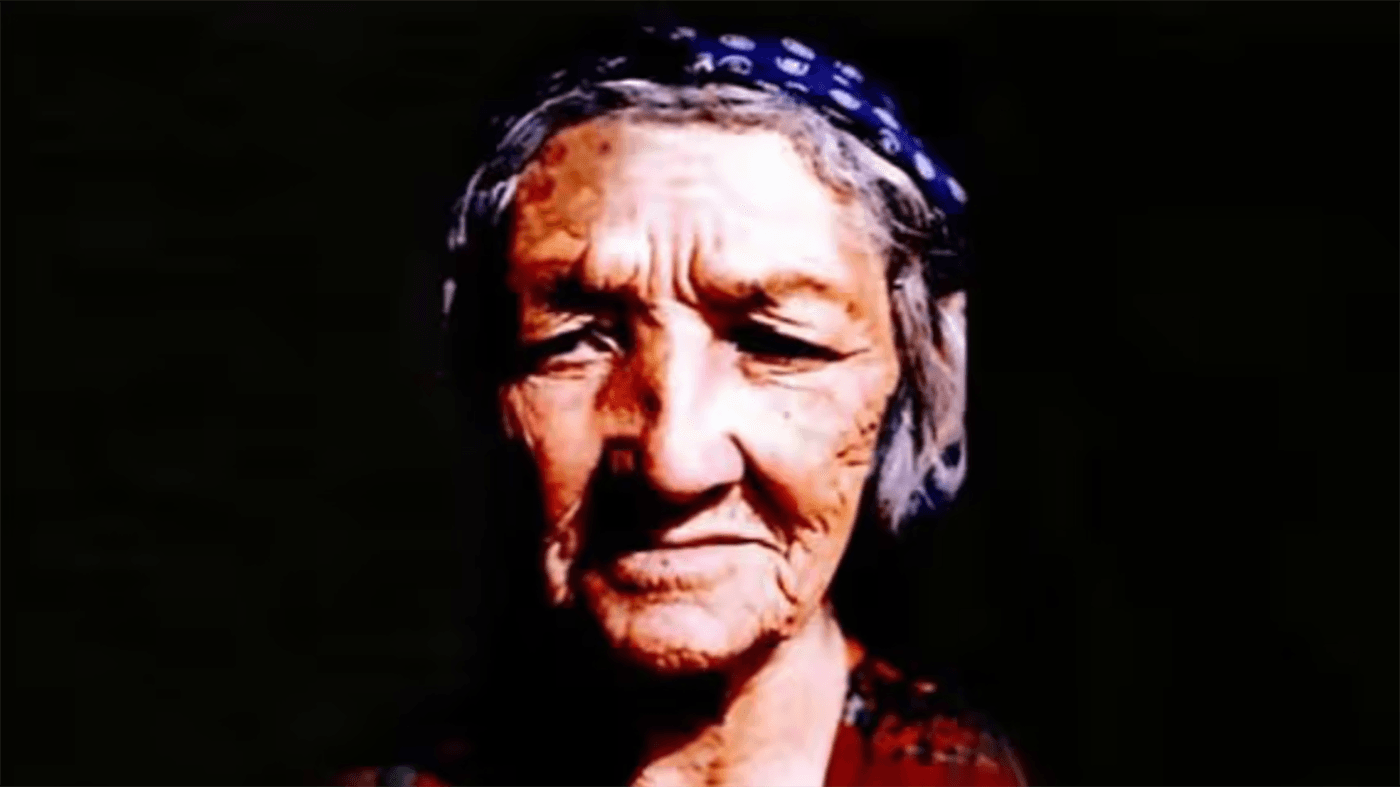
Dambura player and singer
Delaram, daughter of Abdul Samad, and also known as Ābe Mirzâ, was born in 1310 HS/ 1931 AD, in the village of Lalchak, in the Malistan district of Ghazni province, from the Molki Dâifolad clan (Fayaz, 1396/ Shariati 1310). Reliable information about her early life is scarce, but according to local sources, she grew up there and began singing. Due to social constraints, she mostly sang in secret, and it was not possible to record her songs in her birthplace (Shariati, 2014; 2017).
Around 1951 (SH 1330) she married a man from the village of Nawdeh, which was known as a center for local music, and moved there to live with her husband. She gave birth to a son, who was named “Mirzâ”. Migration and the birth of her son had an important role in her singing, and thus she became known in the region as “Abe Mirzâ” or mother of Mirza (Fayaz, 2017).
Her unique singing style, which people called the “Malistani style,” was unique and drew the attention of many. She mostly sang at family and women’s gatherings, and her songs spread to surrounding areas. Some musicians were also inspired by her.
Her growing fame as a female singer forced her to leave her home and wander for a time in Ghazni city and Jaghori district. In Ghazni and Kabul, she even faced imprisonment and once she was taken to court because of her performances, which were deemed unacceptable in that society. However, even in prison, she did not stop singing and playing. Her artistry in prison earned her release after three years.
According to some accounts, after her release she lived for a time in Kabul, then returned to Nawdeh in Malistan district (Sirat, 1386), continuing to sing. According to another account, she lost her husband and son after going to prison, and as a result her voice “burned,” so she gave up singing. Because of the difficulties she faced in her life, there is little precise information about her later works and life.
Although there is little concrete information about her life, her artistic style became well-known thanks to Safdar Ali Malistani, another singer from the same region, who passed away in Kabul in 2012. With his voice, he followed the “Malistani style” and presented many of her songs, making the style famous. Some thought he imitated her voice so closely that people confused his songs with hers. The motive behind Safdar Ali’s actions is unclear, but since both lived in the same village, there may have been familial or emotional ties between them. It appears that Safdar Ali Malistani, at the beginning of his artistic career, was not entirely reluctant to take advantage of Abe Mirza’s fame. However, after gaining recognition in artistic circles and entering Afghan radio and television, Safdar Ali emerged from obscurity and began using his own name (Seerat, 2007; Fayyaz, 2017), and his reputation was built upon her legacy. Safdar Ali’s voice played a major role in this rise to fame. There are cassettes released under the name Abe Mirza, but it is not clear whether they were actually sung by her or by Safdar Ali Malistani (Fayyaz, 2009). Even so, among the people of Malistan, the name Ābe Mirzâ remains remembered as a symbol of the unique “Malistani” singing style.
There is also a version of the story that not only denies Abe Mirza being a singer but claims that her artistic persona was a creation of writers who, without knowing her real character, sought to mythologize her. According to these accounts, Abe Mirza was a woman from Malistan who occasionally sang at gatherings but was not a well-known singer (Ahmadzada, 2017). However, according to both versions, Abe Mirza spent her final years in old age and frailty in her modest home in the small village of Gorgak and passed away there on July 21, 2016 (Fayyaz, 2017).
Author: Hossein Rahyab (Balkhi)
References:
Ahmadzada, Kaweh. (2017). Online interview of Hossein Rahyab with Kaweh Ahmadzada, August 26, 2017.
Seerat, Basir. (2007). “Abe Mirza Has Her Own Musical Style.” Honarmand Magazine, Vol. 1, No. 3, p. 38.
Shariati, Hafiz. (2014). The Oral Culture of the Hazara People. Kabul: Amiri.
Fayyaz, Mohammad Hossein. (2017). Personal Notes of Mohammad Hossein Fayyaz on Abe Mirza.
Fayyaz, Mohammad Hossein. (2009). “The Music of Malistan: From Margin to Mainstream.” Ya To Ya Hichkas Blog. Retrieved July 28, 2017, from ashiqdilbakhta.blogfa.com.
Loading comments...