
Âl-Khaatu/ Al-Khatu is, according to traditional belief, a supernatural being that causes the death of women during childbirth. In the past, women giving birth often suffered from heavy bleeding, pain, and infection, and without doctors or medicine, many of them died. Since people were unable to treat such cases, they believed that a mysterious, paranormal, jinn-like creature was responsible for the deaths. The belief in Âl-Khatu was not limited to the Hazaras; it was widespread throughout Afghanistan and even existed in neighboring countries.
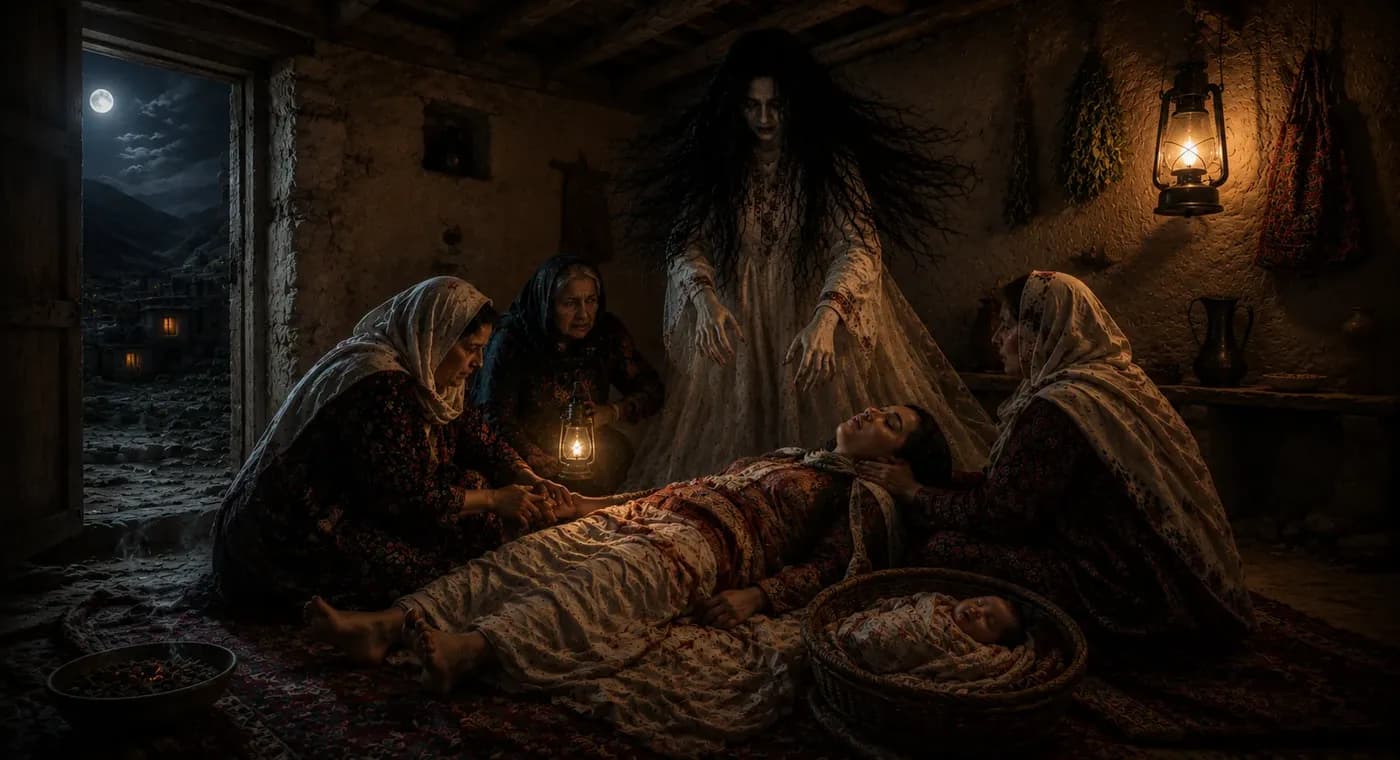
In different regions, this being is known by other names — Âl, Mother Âl, Âl-Khatu, Al-Khatoon, or Al-Khatoonk. Although the details vary from place to place, the creature is usually described as a terrifying woman with long disheveled hair, a large body, and bulging eyes. Across different regions, three features are consistently mentioned: she is a woman, she is frightening, and she can take on many forms.
According to the people of Ghor, Âl-Khatu is a beautiful and mysterious woman with a passion for horse riding, who lives among ruins and deserted places. She can appear and disappear at will (Ghoori, 2019).
It is believed that Âl-Khatu always exists but becomes active mainly during childbirth. Although she herself is female, her main act is killing women in labor. When a woman giving birth loses consciousness due to pain or bleeding, Âl-Khatu is said to appear, remove the woman’s heart and liver, place them in a sieve, carry them to the bank of a stream, and mournfully sing:
“I am Âl, in my hands I cry,
What can I do? I have no power over myself.”
(Alizadeh Malistani, 2014)
In different regions, various methods were believed to protect against Âl-Khatu or neutralize her efforts:
1. Obtaining a talisman from a mullah. People believed that if the mullah’s talisman was effective, Âl-Khatu would return the woman’s internal organs to their place, saving her life. If the charm failed, Âl-Khatu would throw the organs into the water, rendering the talisman powerless and causing the woman’s death.
2. Keeping the woman conscious. Because Âl-Khatu attacked unconscious women, people would slap the woman’s face to keep her awake.
3. Holding or piercing the tongue. They believed that if the woman’s tongue fell back into her throat, she would die. To prevent this, attendants held her tongue in place; if that failed, they pierced it with a large needle (jowaldooz) to keep it from slipping down (ibid).
4. Making dogs bark. Since Âl-Khatu was said to fear dogs, people tried to make dogs bark near the house so that she would not come close (Maqsoodi, 1989: 55).
Some people would also burn espand (harmal seeds) and badra believing that Âl-Khatu fled from their smoke. In some places, people even fired guns into the air during childbirth to scare her away.
It was also believed that for three nights after childbirth, someone should stay beside the mother and newborn so that Âl-Khatu or other spirits could not approach. Usually, on the first night, young boys of the village would keep watch till morning; on the second night, young girls; and on the third, members of the household. If no one could stay awake, a lamp was kept burning until morning (Fayaz, 2019).
Author: Sayed Eshaq Shojaei
References:
Alizadeh Malistani, Azizullah (2018). Superstitions and Racism. Kabul: Beed & University Press.
Ghoori, Kheir-ul-Hada (2019). “Folk Beliefs of the People of Ghor.” Jam Ghor Website. Retrieved 8 December 2019.
Fayaz, Mohammad Hossein (2019). “Notes on the Entry for Âl-Khatu.” Posted 25 March 2019.
Maqsoodi, Abdul Hossein (1989). Hazarajat: The Land of the Deprived. Quetta: Beena Press.
Loading comments...