
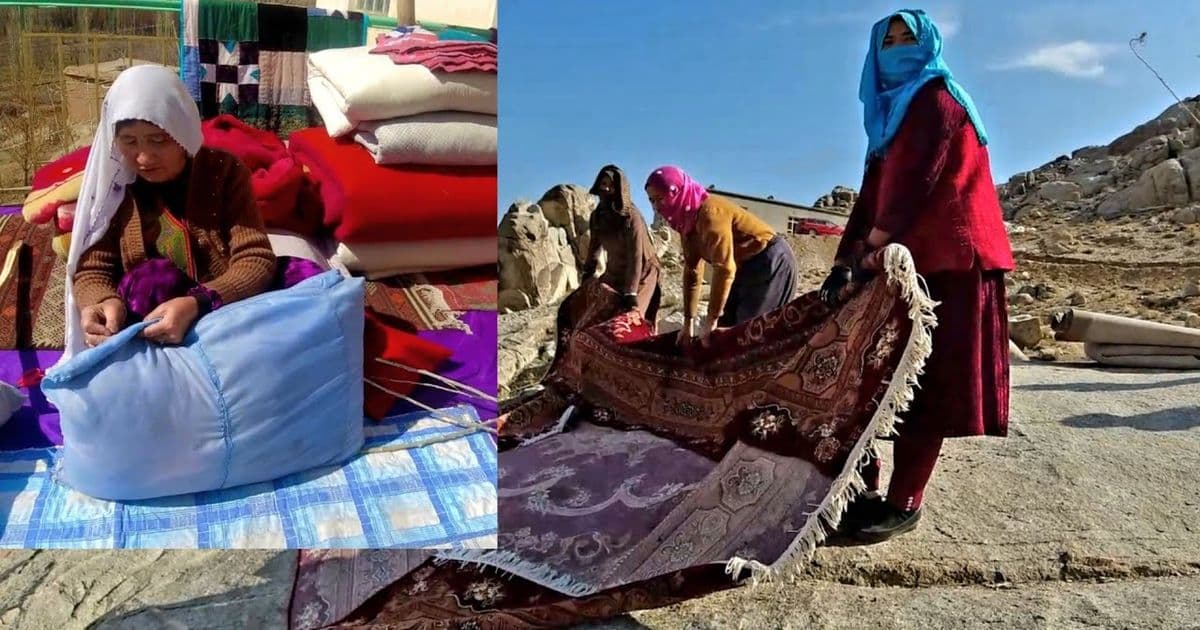
Âshu means cleaning the house from dust and smoke, and whitewashing it. Among the Hazara people, when spring and the Eid festivals (Eid Nawruz, Eid al-Fitr and Eid al-Adha) arrive, they thoroughly clean their homes — washing quilts, mattresses, and rugs, or spreading them out under the sun. Painting or whitewashing the house with white clay and lime is also part of this custom (Mohammadi Shari, 2013: 109). In some areas, this tradition is called “whitening the walls/house”.
Every summer, when villagers moved from their dewal (main house) to their kuta or kolba (small summer huts), and later returned to the dewal after summer, they would whitewash the walls again. The paint was made by mixing a special type of white clay with water (Mozaffari, 2019).
The word Âshu probably originates from the Avestan term Âshu anghen, meaning pure, good, or righteous (Bahrami, Vol. 1, 1990: 178). This root appears in the name of the prophet Zoroaster — Ashu Zarathushtra — meaning the truthful and pious Zarathustra (ibid., p. 181).
During joyous occasions such as weddings, the house would also be painted in white and decorated. The living room and guest room were painted in two colors: the upper part of the walls in white clay, and the lower part (about one gaz in height) in red or green clay. This entire process was called Âshu kardan (“doing Âshu”).
Based on field research conducted by the author via social media communication, the term Âshu is still used in the provinces of Ghazni and Uruzgan, including areas of Jaghori such as Almitu (Sharifi, 2019), Tamqul Loman (Hasani, 2019), Tabaquos (Mirzaei, 2019), and Zirek (Sharifi, 2019), as well as Qarabagh district (Alami Zabili, 2019).
Author: Shokut Ali Mohammadi Shari
References:
Bahrami, Ehsan (2013). Dictionary of Avestan Words. 1st ed. Tehran: Balkh Foundation, Nishapur.
Hasani, Yasin (2019). Online interview by Shokut Ali Mohammadi Shari, December 2019.
Shayan, Mohammad Shah (2019). Online interview by Shokut Ali Mohammadi Shari, December 2019.
Sharifi, Ramazan Ali (2019). Online interview by Shokut Ali Mohammadi Shari, December 2019.
Alami Zabili (2019). Online interview by Shokut Ali Mohammadi Shari, December 2019.
Mohammadi Shari, Shokut Ali (2013). Avestan in the Hazaragi Dialect. Kabul: Sobh-e Omid Press.
Mozaffari, Abu Talib (2019). In-person interview by Shokut Ali Mohammadi Shari, December 2019.
Mirzaei, Habib (2019). Online interview by Shokut Ali Mohammadi Shari, December 2019.
Loading comments...