
Âshâr is a tradition of social cooperation. It is likely that the word Âshâr originates from Ḥashar (حَشر), meaning collective social assistance without pay, a practice still common today (Shahristani, 1982: 21). Some sources use Âshâr, while others use Ḥashar both of which carry the same meaning (La‘li, 1993: 9). In northern Afghanistan, it is pronounced Ašar, the colloquial form of Ḥashar (Shojâ‘ee, 2019).
In Arabic, Ḥashar means “gathering people” or “mobilizing” (Amid, vol. 1, 1981: 794). According to Arianpour, citing Edmund and Beyhaqi, King Mahmud and Mas‘ud Ghaznawi conscripted peasants through Ḥashar for unpaid labor, and there existed a decree determining how such Ḥashar labor was to be carried out (Arianpour, 2013: 88–89). Gharjestani likewise equated Âshâr with corvée labor (Gharjestani, 1989: 126).
However, when Ḥashar is organized by the state, it constitutes forced unpaid labor, whereas when it is initiated by the community for mutual benefit, it becomes a voluntary and cooperative act (Fayyaz, 2016: 85).
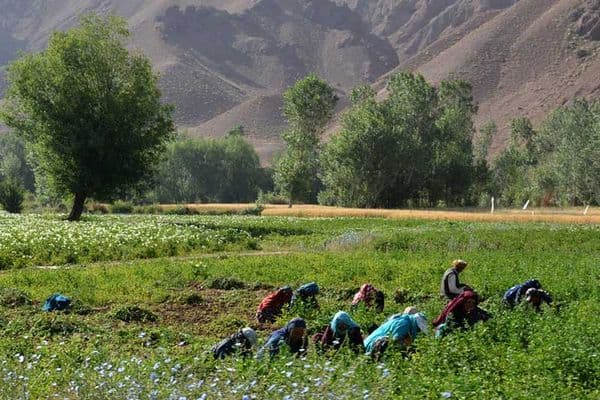
In Hazarajat, people invite each other for collective assistance in activities such as house construction, harvesting, felt-making, wheat grinding, snow shoveling, and road building (Farhang, 2001: 392). In Bâghchâr of Urozgan, this tradition was most often used for gathering winter firewood. Each participant contributed with their own donkey. Groups would go to the desert together and collect enough fuel for the entire winter in a single day (Mozaffari, 2019). Sometimes the number of helpers reached seventy or eighty people.
During large Âshâr wheat harvests, the host usually served mutton to the participants and invited close relatives and neighbors in addition to the helpers. Throughout the day, one worker would chant loudly to motivate the group (a custom called “Allah-dost”) while others responded with cries of “Allah, Allah” or “Yâ Ali, Yâ Ali” (Fayyaz, 2016: 85). In some areas, a man would sing:
“Jal jali o bal bali / The kingdom is God’s, the throne is Ali’s / Allah o Mawla Ya Ali / Whoever is a friend of Ali, say Ya Ali!”
Upon hearing “Ya Ali,” the workers would resume their task with renewed energy and speed (E‘temadi, 2019).
At night, the ceremony concluded with the Âshâr-giver’s blessings, commonly expressed as:
“May God reward you in the Hereafter,”
“May the Commander of the Faithful be your protector,”
“May your children’s lives be blessed,”
“May your harvest be in the Hereafter” (Va‘ezi, 1997: 49).
According to poet and researcher Hafizullah Shari‘ati, Âshâr also carries emotional and human motivations. The fatigue of solitary, monotonous work is replaced by the joy of engaging in lively, shared labor, strengthening bonds of friendship, neighborhood, and kinship. These are the main motivations behind Âshâr within the agrarian culture of the Hazaras (Shari‘ati, 2013: 22).
References:
Arianpour, M. A. (2013). Bamyan, the birthplace of the Hazaras. Kabul: Arif.
E‘temadi, J. A. (2019). Personal interview by Zahra Hosseinzadeh, 10 Sunbula 1398.
Shojâ‘ee, S. E. (2019). Personal interview by Zahra Hosseinzadeh, 6 Sunbula 1398.
Shahristani, Sh. A. (1982). Dictionary of Hazaragi Dialect. Kabul: Kabul University.
Shari‘ati, H. (2013). Hazara Agriculture. Isfahan: Qaimiyeh Research Center. (Available at www.ghbook.ir)
Amid, H. (1981). Amid Dictionary (2 vols). 3rd ed. Tehran: Amir Kabir.
Gharjestani, M. I. (1989). History of the Hazaras and Hazaristan. Quetta: Afghan Islamic Cultural Council.
Farhang, M. H. (2001). Sociology and Anthropology of Afghan Shi‘as. Qom: Imam Khomeini Institute.
Fayyaz, M. H. (2016). Pathology of Inter-Shi‘a Ethnic Relations in Afghanistan. 2nd ed. Qom: Al-Mustafa International Publishing.
La‘li, A. D. (1993). “Sociological Analysis of Hazara Ethics.” Weekly Wahdat, Year 3, No. 102, p. 9.
Mozaffari, S. A. (2019). Personal interview by Zahra Hosseinzadeh, 6 Sunbula 1398.
Va‘ezi, H. (1997). “Religion and Social Traditions in the Hazara Community.” Dorr-e-Dari Quarterly, 1(3–4), pp. 46–58.
Author: Mohammad Hossein Fayyaz
Loading comments...