From Folk Customs
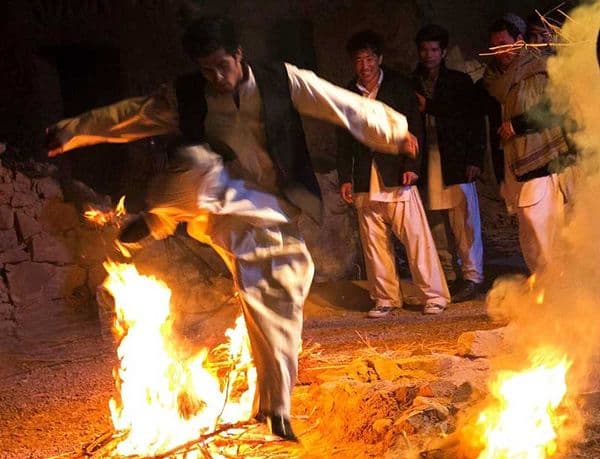
Âtaŝ Alğu refers to the custom of jumping and leaping over fire. Based on an ancient tradition in Hazarajat, a large fire was lit in a firebox at the entrance of the house, and people would take turns jumping (alğu) over it (Mohammadi Shari, 1393: 423). This custom was practiced in Ghazni, Daizangi, and, to some extent, in other parts of Hazarajat (Mansurvā, 1369: 58). It continued in Yaka Olang district, Sangtakht, and the Alawdal region of Sharistan until about 30 years ago (Jafari, 1396).
This ancient ritual was observed in the central regions during four specific months, known as the first, second, third, and fourth Alğus (Mohammadi Shari, 1393: 423). Mansurvā believed it was tied to the new moon and performed four times a year in Daizangi, while in Jaghuri it took place once annually, on the thirteenth of the month of Safar (Mansurvā, 1369: 58). Polādi (1381: 265) supported the latter account but did not mention the thirteenth of Safar, while locals associated the ritual with the night of the last Wednesday of the solar year (Jafari, 2017; Mahdawizadah, 1396). In other reports, it was said to occur on the last Wednesday of Safar in the Sangtakht area (Ebrahimi, 1396).
Despite variations in timing, the manner of performing Fire Alğu remained largely the same. Participants jumped over the fire collectively and rhythmically, chanting verses to invite good fortune and banish evil (Ataei, 1393: 43). In Daizangi, four fires were lit in front of each house. The head of the family would leap first, chanting: “The good is coming, and the bad is leaving.” Those gathered around would respond: “Mūtak bur biya Alğuko ke mūtak to bur mūsha” (Polādi, 1381: 265). Onlookers encouraged the jumpers with the refrain: “Luck come, worry go” (Polādi, 1381: 265).
During the men’s leaps, women would climb onto rooftops with clay jugs of water. From above they shouted: “This neck is broken, but if you leap over the fire, it will recover.” They then hurled the jugs to the ground, shattering them (Mansurvā, 1369: 58). In some regions, people murmured: “Luck come, grief go” (Mohammadi Shari, 1393: 423).
The ritual of jumping over fire had two main purposes: first, as an ancient cultural practice intended to drive away misfortune and attract good luck; and second, as a form of play and entertainment (Mohammadi Shari, 2014: 423).
From very early times, fire has held an important place in Hazara customs, ethics, and traditions. For example, in Jaghuri, during the Feast of the Dead, a lamp was lit for the soul of each deceased person (Mansurvā, 1369: 58).
Author: Mohammad Hossain Fayaz
Sources: Ebrahimi, J. (2017). Internet interview of Mohammad Hossain Fayaz with Jamilah Ebrahimi, July 10, 2017. [In Persian];Pouladi, H. (2002). Hazaras (A. A. Kermani, Trans.). Tehran: Erfan. [In Persian];Jafari, M. B. (2017). Oral interview of Mohammad Ali Borhani Sharistani with Mohammad Baqir Jafari, July 10, 2017, Mashhad. [In Persian];Atayi, S. (2003). Hazara rituals. Aparvand, 2(11), 34–62. [In Persian];Mohammadi Shari, S. A. (2014). Cultural geography of ancient Ghazni. In Ghazni, the cradle of Islamic Eastern civilization (Vol. 1). Tehran: Erfan. [In Persian];Mansurva, A. Sh. (1990). On the socio-economic situation of the Hazara people (H. Yareqin, Trans.). Gharjistan Journal, 3(2), 35–60. [In Persian];Mahdavi Zadeh, A. (2017). Internet interview of Mohammad Hossain Fayaz with A. Mahdavi Zadah, July 10, 2017. [In Persian]
Loading comments...